
Does a December close make sense when incorporation is only weeks away? A Singapore company's first financial year end could instead fall on a later date, such as 30 June. Bizfile asks for the date before registration is complete. For someone incorporating in mid-November, that means choosing between 31 December, only weeks away, and a later close.
The choice is more than an accounting formality. It fixes the year of assessment for your first accounts. It also sets the clock for Estimated Chargeable Income filing, the annual general meeting, the annual return and the first corporate income tax return.
A date chosen casually can create a short statutory cycle covering little more than setup activity, or open your start-up tax exemption window before you trade. A date chosen deliberately gives you a meaningful first set of accounts without breaching the first-year limits.
In this blog, we explain the rules from ACRA and IRAS. We compare December and June closes for a company incorporated on 16 November 2026. We also share the factors our team weighs when advising founders on this decision.
Table of Contents
What Rules Govern a New Singapore Company's First Financial Year End?
Two authorities matter here: the Accounting and Corporate Regulatory Authority (ACRA) for the accounting and filing side, and the Inland Revenue Authority of Singapore (IRAS) for tax. ACRA asks for your financial year end when you register through Bizfile, alongside your office address and company email. The rules below frame every year-end decision that follows.
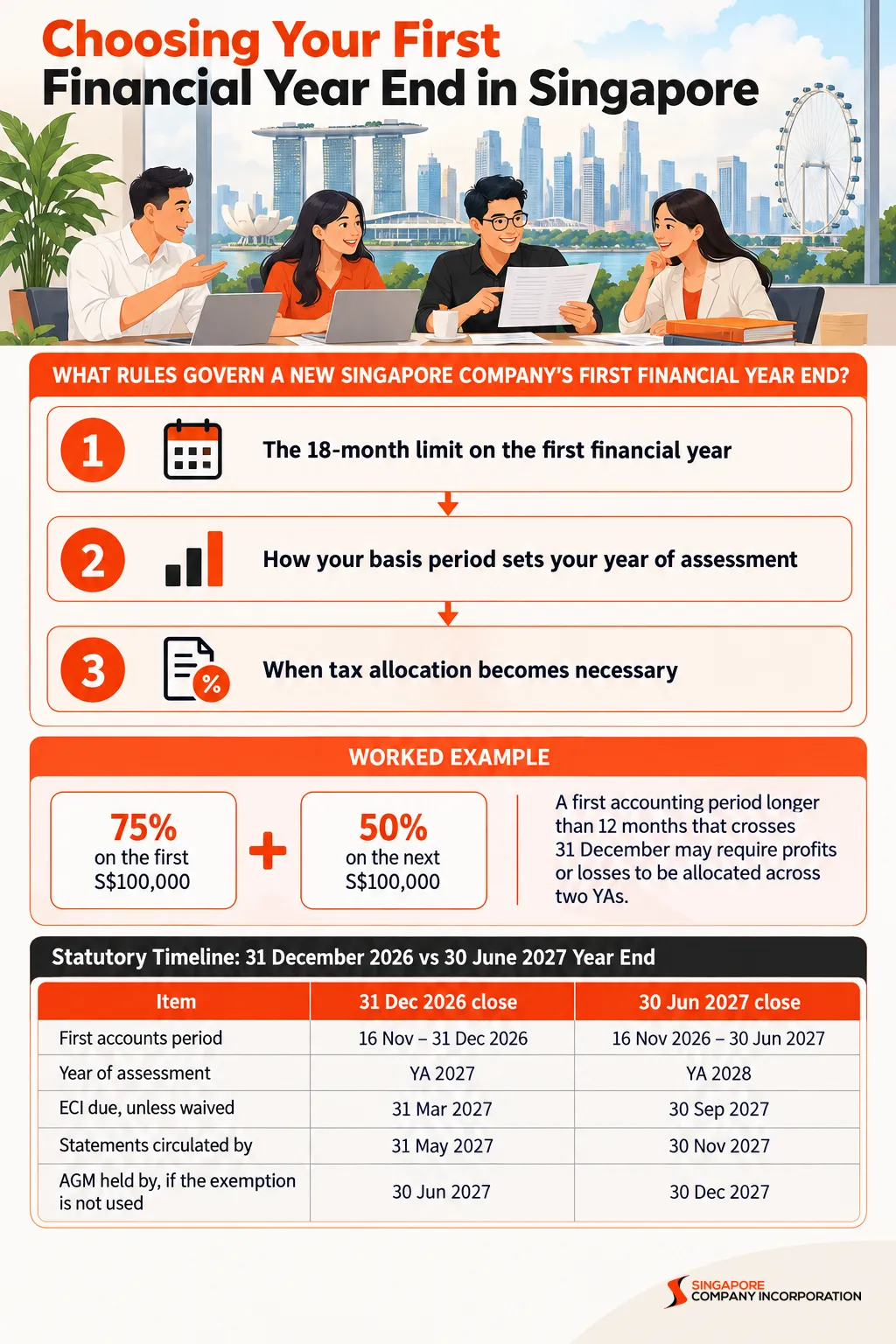
1. The 18-month limit on the first financial year
The Companies Act allows a first financial year of up to 18 months. A first financial year cannot exceed 18 months unless the registrar approves. In practice, most founders stay comfortably inside this limit.
2. How your basis period sets your year of assessment
IRAS ties your company to a year of assessment (YA) based on the calendar year in which your accounts close. A first period ending 31 December 2026 falls in YA 2027. A first period ending 30 June 2027 falls in YA 2028.
3. When tax allocation becomes necessary
A first accounting period longer than 12 months that crosses 31 December may require profits or losses to be allocated across two YAs. Crossing 31 December does not by itself split a period of 12 months or less into two YAs. That allocation exercise is separate from ACRA's 18-month limit.
Should You Close Your First Accounts in December or Wait Until June?
To make the trade-off concrete, we use a worked example — an illustrative scenario, not a client file. For someone starting a management consultancy business in Singapore, the same comparison applies. Assume a private, unlisted company incorporated on 16 November 2026, with no overseas branch register and no audit requirement.
Option A closes the first accounts on 31 December 2026, roughly six weeks after incorporation. Option B closes on 30 June 2027, about seven and a half months in. Both periods are shorter than 12 months, so both sit within the 18-month first-year limit and neither triggers a long-period tax allocation.
ACRA generally requires a non-listed private company to hold an annual general meeting (AGM). The meeting is due within six months of the financial year end, unless an exemption or dispensation applies. One common exemption route is sending the financial statements to members within five months of the year end, and members keep the right to request a meeting. The annual return then follows within seven months for a non-listed company without an overseas branch register. ACRA's fee schedule lists an annual returns filing fee of S$60, a government fee separate from any service provider's charges.
For the 30 June year end, the meeting and annual return dates in the table below follow ACRA's own published example for a June financial year end. Confirm the exact dates with your corporate secretarial adviser, because extensions and overseas branch registers change the picture.
Statutory Timeline: 31 December 2026 vs 30 June 2027 Year End
| Item | 31 Dec 2026 close | 30 Jun 2027 close |
|---|---|---|
| First accounts period | 16 Nov – 31 Dec 2026 | 16 Nov 2026 – 30 Jun 2027 |
| Year of assessment | YA 2027 | YA 2028 |
| ECI due, unless waived | 31 Mar 2027 | 30 Sep 2027 |
| Statements circulated by, for the exemption route | 31 May 2027 | 30 Nov 2027 |
| AGM held by, if the exemption is not used | 30 Jun 2027 | 30 Dec 2027 |
| Annual return filed by | 31 Jul 2027 | 30 Jan 2028 |
| First corporate income tax return, if required | 30 Nov 2027 | 30 Nov 2028 |
How Does Your Year End Change Your First Tax Filing in Singapore?
Your chosen date decides when each tax obligation first falls due, and which YA your first accounts occupy. The framework below reflects IRAS rules confirmed as at November 2026.
1. Estimated Chargeable Income deadlines
Estimated Chargeable Income (ECI) is generally due within three months of the financial year end, unless a waiver applies. On the worked dates, that means 31 March 2027 for the December close and 30 September 2027 for the June close. A new company's ECI filing deadline is one of the first dates to put on your compliance calendar.
2. The ECI waiver needs two conditions
The waiver from filing ECI requires annual revenue of S$5 million or less and nil ECI for the period. ECI is tested before start-up or partial tax exemption is applied. A loss or the absence of sales alone does not qualify a company.
3. Start-up exemption and the year-end clock
Eligible new companies receive an enhanced exemption on normal chargeable income for their first three consecutive YAs: 75% on the first S$100,000 and 50% on the next S$100,000. A loss-making or nil-income YA still consumes one of the three. Companies that do not qualify receive partial exemption instead. Eligibility depends on incorporation in Singapore, tax residence, shareholder composition and business activity, so verify it before counting on the saving.
Tax Treatment: How the Two Year Ends Compare
| Tax point | 31 Dec 2026 close | 30 Jun 2027 close |
|---|---|---|
| Period longer than 12 months | No | No |
| Long-period allocation across two YAs | Not needed | Not needed |
| ECI waiver, nil ECI and revenue of S$5 million or less | Possible only if both conditions are met | Possible only if both conditions are met |
| Start-up exemption window opens | YA 2027 | YA 2028 |
| ECI tested before exemption | Yes | Yes |
| Pre-commencement expenses | Need separate review | Need separate review |
How Do Filing Obligations and Business Priorities Affect Your Year-End Choice?
Suppose a new company closes its first accounts in its incorporation year. If it commenced business or received income that year, it must file for the following YA, even at a loss. If it did neither, IRAS's first-return exception may apply. Check the company's status in the mytax portal rather than assuming a reminder will arrive. Directors remain responsible for timely and accurate filing. Late filing can attract penalties of up to S$5,000.
On the worked dates, the December option's first return is due by 30 November 2027, and the June option's by 30 November 2028. Both dates assume the company files for that YA and that no waiver has been granted.
When founders come to us late in the year, our team looks past the calendar to three factors. The same reasoning applies whether you incorporate in November or any other busy month.
1. A genuine external reporting requirement
If a foreign parent, investor or lender needs statutory December accounts, a December close usually makes sense. If they only need December management figures, that alone does not require a separate statutory close.
2. When trading actually starts
A company already invoicing profitably in November can justify a December close. A founder still doing setup work until the new year gains little from it, and may use one of the three start-up exemption YAs with no immediate benefit.
3. The cost of an extra short cycle
A short first period requires an annual return; financial statements are also required unless the company qualifies as a dormant relevant company. A tax return may also be required, although IRAS's first-return exception can apply. If nobody needs those December accounts, a later first close may avoid the extra short cycle. It does not reduce bookkeeping, because monthly records should start at incorporation either way.
December or June: What Tips the Decision
| Factor | Points to December | Points to June |
|---|---|---|
| External reporting | Parent, investor or lender needs statutory December accounts | No external statutory calendar to meet |
| Trading status | Invoicing profitably before the year end | Setup only, with revenue months away |
| Compliance budget | Room for an extra short accounting and tax cycle | Prefer to avoid a second short cycle |
| Bookkeeping | Monthly books still required from incorporation | Monthly books still required from incorporation |
What Should You Check Before You Set the Date?
Budgeting also matters here. Registration itself already carries ACRA's S$15 name application fee and S$300 incorporation fee, so many founders prefer not to add a compliance cycle that nobody asked for. Whichever date you lean towards, a few checks protect you from the problems our team sees most often with late-year incorporations. You can also optimise your tax filing process in Singapore by planning deadlines early.
1. Keep records from incorporation day
IRAS requires proper records of financial transactions, and transactions start before sales do. Share capital, incorporation costs and bank movements all belong in the books from day one.
2. Review pre-commencement expenses separately
Expenses incurred before the business commences need their own tax review. Deductibility depends on the expense and the applicable rules, so an accounting loss does not automatically mean a tax loss.
3. Do not wait for a reminder
Filing windows open by date, not by notification. Put the ECI, annual return and tax return dates on a calendar at incorporation. Set up your processes before the first deadline nears.
Conclusion
A late-year incorporation does not force a December close. Both a 31 December and a 30 June first financial year end sit within the 18-month limit, and neither splits your first accounts across two years of assessment. The difference lies in timing: which YA your accounts occupy, when ECI, AGM, annual return and tax return fall due, and when your start-up exemption window opens.
Our approach starts from your facts: when revenue is expected, who needs statutory accounts, what your compliance budget looks like and whether the exemption conditions are met. Our team can discuss registration, record-keeping and ACRA and IRAS filing needs with you.
If you are incorporating in the closing weeks of 2026 and unsure which date to enter in Bizfile, speak to our team at sgcompanyincorporation.com before you file. We will walk through the two timelines with you and recommend the year end that fits how your business will actually trade.
Set the Right Year End Before You Incorporate
Our team can review your expected trading start, reporting needs and budget, then recommend a first financial year end and handle the filings that follow it.
Frequently Asked Questions
Yes. A first financial year can run up to 18 months without needing the registrar's approval. If it is longer than 12 months and crosses 31 December, profits or losses may need to be allocated across two years of assessment, which is extra tax work.
Estimated Chargeable Income is generally due within three months of the financial year end. A waiver applies only if annual revenue is S$5 million or less and ECI is nil, tested before any start-up or partial tax exemption.
No. If the first accounting period is 12 months or less, it falls within a single YA: the calendar year following the year in which the period ends. Only periods longer than 12 months that cross the year end raise an allocation question.
Generally yes, if the company carried on business or received income during the period. A company that neither commenced business nor received income may fall under IRAS's first-return exception. Check the company's status in the mytax portal rather than waiting for a reminder.
A non-listed private company generally holds its AGM within six months of the financial year end, unless an exemption applies, such as circulating financial statements to members within five months. The annual return follows within seven months, with an ACRA filing fee of S$60.

SG Company Incorporation
Author
SG Company Incorporation is a Singapore corporate services provider that helps entrepreneurs and foreign investors register a company in Singapore and keep it compliant, with support for company secretarial, nominee director and tax filing needs.