
A director in Singapore cannot validly resign if the resignation would leave the company with no director ordinarily resident in Singapore, unless the director is required by law to resign or vacate office. That single rule shapes every plan to replace a nominee director in Singapore — the timing, the filing order, even the wording of the resignation letter.
Most nominee arrangements begin as a bridge. A foreign founder registers the company but cannot yet serve as the local resident director. They rely on a professional nominee until permanent residence, an eligible pass or another resident director is secured. When that day arrives, the change itself becomes a project: ACRA filings, statutory registers, nominee disclosures, bank mandates and contract notices all need to move in the right order.
Handled carefully, the transition is routine. Handled in the wrong order, it can leave the company without a valid resident director, expose it to penalties, and disrupt banking and government portal access for weeks afterwards.
This guide sets out the legal baseline from ACRA and the documents to prepare. It then walks through a cautious filing sequence, the nominee-register updates many companies miss, and the operational handover that completes the job. In this blog, we discuss how to make the change safely, step by step.
Table of Contents
What Rules Apply When a Nominee Director Steps Down in Singapore?
Two rules govern the exit. First, the company must keep at least one director who is ordinarily resident in Singapore at all times. Second, the resignation must follow whatever the company's constitution requires — some constitutions add notice periods, member approval or other conditions. ACRA's guidance treats both as the legal baseline, and the constitution can impose more, never less.
ACRA also requires the company to notify it of a director's appointment, and of a resignation or other cessation, within 14 days. For the exact filing steps, our ACRA BizFile guide on how to register a Singapore company and file company changes walks through each submission screen. That filing window is administrative. It is not permission to run the company without a resident director while the paperwork catches up.
A nominee director is a full director in law. The duties, disclosure obligations and potential liabilities that apply to any director apply to a nominee as well, and they continue until the legal position is properly resolved. A nominee arrangement is not name lending, and ACRA's director-duties guidance makes that point expressly.
Keep the same discipline you applied during the steps to incorporate a company in Singapore: complete records, current consents and clean resolutions. An officer change is, in substance, a repeat of that exercise for one person.
What Documents Do You Need to Replace a Nominee Director?
From our work supporting companies through officer changes, the file falls into two halves: documents for the incoming resident director and documents for the outgoing nominee. Both halves should be complete before anything is lodged with ACRA.
1. Proof that the replacement qualifies
An approval-in-principle for a work pass is not proof that a founder already qualifies as the local resident director. Check the issued pass, any conditions attached to it, and the person's actual residence circumstances. Holders of a Foreign Identification Number (FIN) should confirm role eligibility with the pass issuer, because not every pass holder is permitted to serve as a director.
2. Consent and declarations from the incoming director
The proposed director signs the current Form 45. This is the consent to act as director and statement of non-disqualification. It is retained in the company's statutory records rather than lodged with ACRA. The form was recently amended, so make sure you use the latest version. Obtain any applicable director-interest disclosures and, if the replacement is also a nominee, the nominator details for the register of nominee directors. Where a prospective director may be disqualified or needs permission to act, take case-specific legal advice.
3. A resignation with a clear effective date and time
The outgoing nominee's resignation should state when it takes effect, and it is safer to include a time where the appointment and resignation overlap on the same day. Address any outstanding fees or indemnities under the nominee agreement, and require the return or deletion of company property and credentials.
4. Resolutions and updated registers
Prepare the board or member resolutions, update the register of directors, and review the register of registrable controllers and the nominee registers where applicable. The company secretary records everything in the minutes.
What Is the Safest Way to Sequence the ACRA Filings?
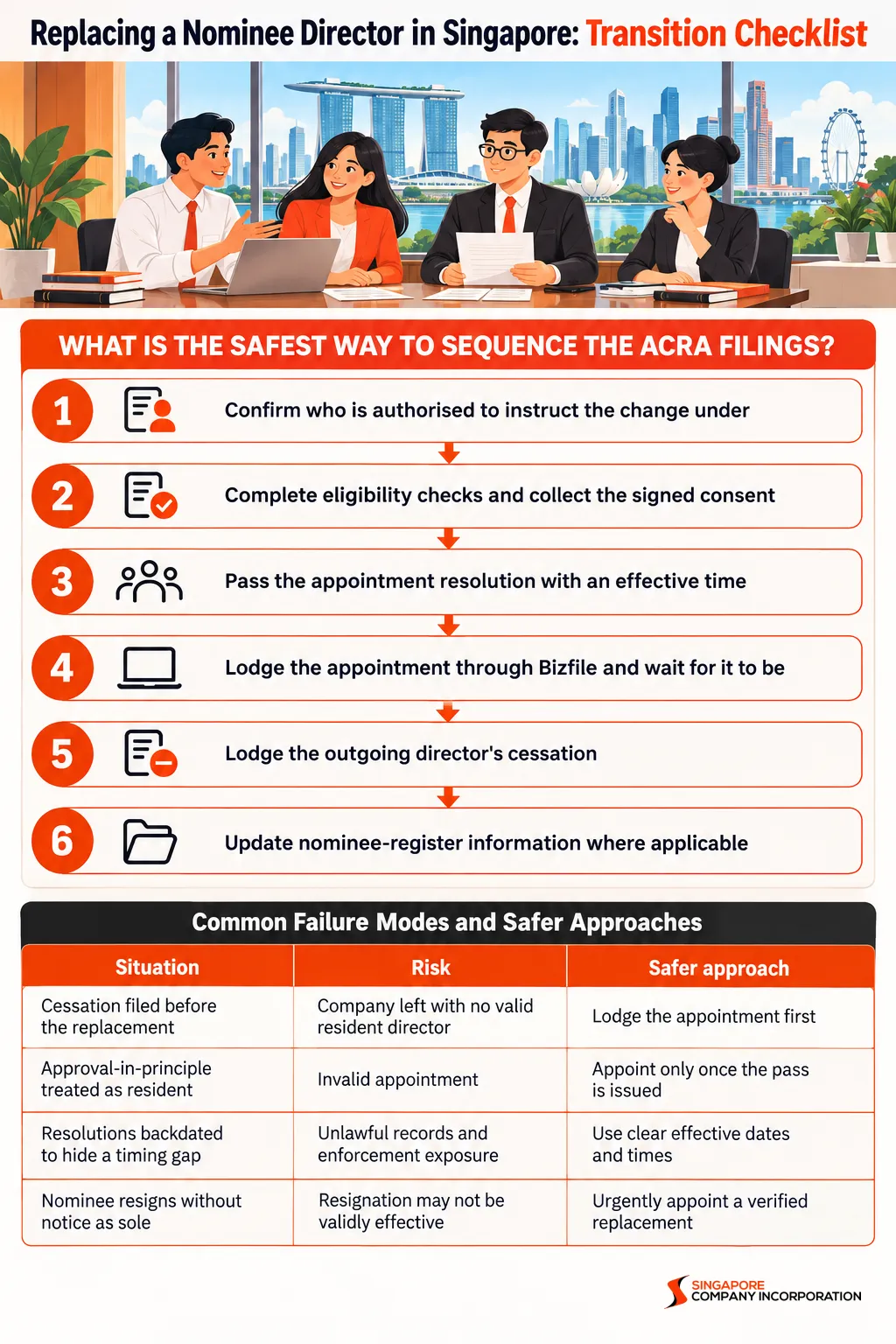
The cautious sequence is to make the incoming appointment legally effective — and lodged — before the outgoing nominee's cessation is filed. This reflects how we coordinate filings for clients, but it is a reasoned working method, not an order ACRA mandates. The constitution, the effective times in the resolutions and any ACRA review can change what is possible.
- Confirm who is authorised to instruct the change under the constitution.
- Complete eligibility checks and collect the signed consent from the incoming director.
- Pass the appointment resolution with an effective time before the resignation takes effect.
- Lodge the appointment through Bizfile and wait for it to be accepted.
- Lodge the outgoing director's cessation, often the same business day once the appointment is confirmed.
- Update nominee-register information where applicable.
- Move on to bank, Corppass, licence, contract and internal-access changes.
Two points about the 14-day notification period: it applies to both appointment and cessation, and it never justifies a gap. A director cannot validly resign if the resignation would leave the company without an ordinarily resident director, unless the director is required by law to resign or vacate office, so build a short overlap rather than a hole.
The classic failure is filing the sole resident nominee's cessation first, on the assumption that the replacement will be accepted immediately. The replacement can be delayed by a missing consent, an endorsement that has not come through, an identification mismatch, a disqualification issue or an ACRA referral. Never backdate resolutions to paper over a gap, and never assume that submitting two transactions together fixes their legal order.
How Do Nominee Registers and CSP Rules Affect the Change?
Where a nominee director is involved, the company's registers of nominee directors and nominee shareholders must be reviewed. The related central ACRA registers must also be reviewed and updated where the arrangement falls within the rules. Exemptions depend on the facts of the nominee arrangement, so treat this as a "where applicable" step rather than a universal one.
Central-register updates are due within two business days after the private register is updated. Do not publish nominator details or other confidential register particulars beyond what the law and the company's own disclosures require.
Since 9 June 2025, a person acting as a nominee director by way of business must be a registered CSP or have the appointment arranged by one, unless an affiliated-company or pre-existing-appointment exception applies. This is required under the Corporate Service Providers Act 2024. The CSP must be satisfied the person is fit and proper. If your replacement is another nominee arranged by a provider, that assessment applies at the time of the new arrangement; it does not apply retrospectively to an outgoing nominee appointed before 9 June 2025.
How Should Responsibilities Be Allocated During the Transition?
Every transition runs more smoothly when each party knows its lane. The allocation below is a suggested division of labour only. Who actually holds authority depends on the constitution, shareholder structure and engagement terms, so confirm this before you begin.
Suggested Roles and Responsibilities
| Role | Suggested responsibility |
|---|---|
| Beneficial owner | Gives the commercial instruction, supplies updated ownership and business information, and acts only within shareholder or board authority |
| Incoming resident director | Signs the consent to act and declarations, completes due-diligence checks and takes office at the effective time |
| Outgoing nominee | Signs the resignation, hands over records, company property and access, and flags unfinished compliance matters |
| Company secretary | Records resolutions, updates statutory registers and minutes, and checks the resident-director requirement continues to be met |
| Corporate service provider | Prepares resolutions and filings, controls the Bizfile sequence and retains supporting records where authorised |
What Should You Hand Over Beyond the ACRA Filing?
Treating the ACRA cessation filing as the whole transition is the most common mistake we see in officer changes. Banking authority, government portal access, guarantees, signing mandates and historical liabilities are separate issues that outlive the filing, and each needs its own owner and confirmation.
1. Bank mandates and payment approvers
Instruct the bank in writing to update signatories, payment approvers and any guarantee positions. Do this after the appointment is effective, and keep the outgoing nominee's access from lingering.
2. Government portal access
Review Corppass users and the authorisations tied to IRAS, licence and grant portals. Stale access in a departed director's name is both a security risk and an audit finding.
3. Licences, contracts and insurance
Update licence-holder records, contract notice parties and authorised signatories, and tell your insurer who the new responsible officers are.
4. Internal credentials and company records
Transfer or close off company email, systems access and any company property held by the nominee. Confirm the statutory registers and minute books are complete before you close the file.
Operational Handover Checklist Beyond ACRA
| Workstream | What to confirm |
|---|---|
| Bank mandate | New signatories and payment approvers recorded; guarantees and standing instructions reviewed |
| Government portals | Corppass users updated; IRAS, licence and grant portal authorisations reassigned |
| Licences and contracts | Licence-holder records, contract notice parties and authorised signatories updated |
| Insurance and credentials | Insurer contacts, systems access, email and company property transferred or closed off |
What Can Go Wrong, and When Should You Pause?
Most difficulties come from sequence and status errors rather than from ACRA itself. If a nominee purports to resign without notice as the sole resident director, the first question is whether the resignation is legally effective at all. Singapore law does not permit a resignation that leaves the company without an ordinarily resident director, unless the director is required by law to resign or vacate office. Preserve the notice, inform the board and shareholder, appoint a verified replacement urgently, and correct the records without backdating.
If the founder's pass is still pending or only approved in principle, the founder is not yet the replacement. The existing nominee stays, or the company appoints another qualifying resident director, until the founder's status is valid and the appointment is permitted.
An incoming CSP will usually run its own onboarding and risk review rather than adopt the outgoing provider's files. Expect fresh identity, ownership and screening checks, and a request for a full handover pack. Situations that warrant pausing and investigating include:
- missing or inconsistent ownership information
- unexplained nominee arrangements
- requests to backdate documents
- pressure to remove the sole resident director before a replacement is in office
- company records that conflict with ACRA data
These are prudent examples to raise with your CSP or lawyer, not a complete legal list. A handover dispute is not automatically evidence of wrongdoing. It does raise the level of independent verification needed. That is the same friction that shows up among the common challenges in company incorporation and officer changes generally.
Common Failure Modes and Safer Approaches
| Situation | Risk | Safer approach |
|---|---|---|
| Cessation filed before the replacement appointment is accepted | Company left with no valid resident director | Lodge the appointment first; keep the nominee in office until it is confirmed |
| Approval-in-principle treated as resident status | Invalid appointment; possible breach of pass conditions | Appoint only once the pass is issued and eligibility is confirmed |
| Resolutions backdated to hide a timing gap | Unlawful records and enforcement exposure | Use clear effective dates and times; never backdate |
| Nominee resigns without notice as sole resident director | Resignation may not be validly effective | Urgently appoint a verified replacement and correct the records without backdating |
Should You Transfer Corporate Secretary at the Same Time?
Many companies replace the nominee at the same time as they change corporate service provider. For instance, the outgoing provider arranged the nominee and the founder now wants a different arrangement. The two changes are related, but they are not the same job.
The incoming provider will typically ask for a handover pack. That pack usually includes:
- the constitution and the current ACRA business profile and filing history
- statutory registers, minutes and share records
- tax filings, licences and material contracts
- bank mandate details and the nominee agreement
It should verify this information independently against ACRA and documents supplied by the company. It should not rely on the outgoing provider's due diligence.
That is also a natural moment to outsource company secretary services. A provider can manage the officer change and the ongoing registers as one coordinated job. Sequence-wise, it is usually cleaner to complete the officer changes first and then the provider transfer — or run both as a single project with one written timeline. Whichever you choose, confirm who files what, and when, in writing.
Conclusion
Replacing a nominee director in Singapore comes down to a few principles:
- Appoint before you resign.
- Keep a qualifying resident director in office at all times.
- Notify ACRA within 14 days of both the appointment and the cessation.
- Use the current Form 45.
- Update the nominee registers where applicable.
- Finish the job with a proper operational handover of bank, portal and contract matters.
Where authority, immigration status, disputes or company records are unclear, take company-specific corporate-secretarial and legal advice before you file. The sequence that works for one company may not work for another.
At SG Company Incorporation, we help local entrepreneurs and foreign investors manage director appointments and resignations as part of our incorporation, corporate secretarial, nominee director and compliance support services. If you are planning a transition, talk to us about a sequence that keeps your company compliant throughout.
Plan Your Director Transition With Confidence
Tell us about your company's situation and we will walk you through the documents, filings and handover steps involved in changing your resident director.
Frequently Asked Questions
Not validly if the resignation would leave the company with no director ordinarily resident in Singapore. The company must maintain at least one ordinarily resident director at all times, and the constitution may impose additional resignation conditions.
The company must notify ACRA of a director's appointment, and of a resignation or other cessation, within 14 days. This filing window does not permit the company to operate without a resident director in the meantime.
No. Check the issued pass and its conditions, and the person's actual residence circumstances. FIN holders should confirm role eligibility with the pass issuer, because not every pass holder may serve as a director.
Form 45 is the consent to act as director and statement of non-disqualification. The incoming director signs it, and the company retains it in its statutory records rather than lodging it with ACRA. Use the latest version, as the form has been recently amended.
Where applicable, yes. The company should review its private nominee-director and nominee-shareholder registers, and central ACRA register updates are due within two business days after the private register is updated. Exemptions depend on the facts of the arrangement.

SG Company Incorporation
Author
SG Company Incorporation is a Singapore corporate services provider that helps entrepreneurs and foreign investors register a company in Singapore and keep it compliant, with support for company secretarial, nominee director and tax filing needs.