
Under Singapore's Home Office Scheme, a home business can keep using a residential address as its business address only while the activities carried on there stay within the scheme conditions. The pressure is usually gradual. Cartons fill a spare room, couriers arrive most weekdays, the team grows, and customers want to visit. Each change can push the venture past what home-based schemes allow.
The confusion starts because Singapore separates three addresses that many founders treat as one. Your ACRA registered office, actual place of operations and customer-facing correspondence address can use different addresses. Each has its own rules. A company can lawfully stay registered at a residential address while its real work happens elsewhere.
Getting this wrong cuts two ways. Breaching the home-based scheme conditions can cost you the approval to operate from home. Leaving a stale or inaccessible registered office can breach the Companies Act. Understanding both rule sets, and the order to act in, is what protects your company.
This guide explains how the registered office differs from operating and correspondence addresses. It also covers what the home-based schemes permit and the signs that your business has outgrown the home. It then explains the ACRA filings and downstream updates that follow a move.
In this blog, we discuss Singapore home-based business rules and how to tell when operations must leave the home. We also explain how to change your registered office address with ACRA correctly.
Table of Contents
How Do a Registered Office, Operating Address and Correspondence Address Differ?
A Singapore company's registered office, its actual operating premises and its correspondence address are three different things. The Accounting and Corporate Regulatory Authority (ACRA) treats the registered office as the official address for communications, notices and the company's records. It does not have to be the place where you carry on business.
ACRA requires the registered office to be a physical Singapore address. It must be open and accessible to the public for at least three hours during normal office hours. This applies on each business day. Saturdays, Sundays and public holidays are excluded. A P.O. box is not acceptable, because official documents must be capable of being received and served at the address.
The registered office address is public information in ACRA's records, so anyone can look it up. That visibility is why some founders prefer a professional address arrangement over their own home. Changing the company's registered office does not change the residential or contact addresses that directors and other position holders have filed.
One caveat: keeping the registered office separate from operations does not satisfy every other requirement. Sector licences, your lease, your insurer and your bank may each need to see the actual operating address, not just the one on the ACRA register.
Registered Office vs Operating Address vs Correspondence Address in Singapore
| Aspect | Registered office | Operating address | Correspondence address |
|---|---|---|---|
| What it is | Official ACRA address for notices, legal papers and company records | Place where the work is actually done | Address used for customers, invoices and returns |
| Who governs it | ACRA under the Companies Act | URA and HDB use rules, lease and MCST restrictions | You and your commercial contracts |
| Key requirement | Singapore address, publicly accessible at least three hours each business day | Permitted use under a home-based scheme or a commercial lease | Must reliably receive mail and messages |
| Public visibility | Yes, shown on the ACRA register | Only if you advertise it | Only where you publish it |
What Can a Home Business Legally Do at a Residential Property?
The first step is to classify the activity, not the company. Singapore offers two main home-based routes, and they permit very different things.
Under the Urban Redevelopment Authority's (URA) Home Office Scheme, a residential unit may be used for small-scale office or administrative functions. Up to two non-resident employees, partners or directors may be engaged at the unit. The activity must be administrative in nature, other business activities must occur elsewhere, and clients or customers may not visit. The applicable route depends on whether the premises are an HDB flat or private residential property. HDB flats follow the Housing & Development Board's Home Office Scheme conditions, while private homes follow the Urban Redevelopment Authority's scheme. Confirm the current HDB, URA, landlord and management corporation (MCST) conditions for your unit.
The small-scale home-based business scheme is narrower. It covers activity carried on by the residents themselves, without non-resident employees, signage, heavy non-domestic equipment, large-scale storage or frequent loading and unloading. Private tuition is limited to no more than three students at a time. These are scheme conditions rather than universal numeric thresholds; the residential character of the premises must remain intact.
For HDB Home Office users, goods storage and loading or unloading are not allowed, and HDB may revoke the approval if conditions are breached. Neither route permits a retail shop, warehouse, clinic or large-scale production facility; the Home-Based Business Scheme does allow specified small-scale hairdressing, facial and beauty services, manicure and pedicure, subject to its conditions. Registering the company at a home address does not itself permit business activity there; any home-based operations must comply with the applicable scheme conditions and other regulatory requirements.
If you are still at the planning stage, our guide to starting a home-based business in Singapore covers the setup basics before these limits become relevant.
Home Office Scheme vs Small-Scale Home-Based Business Scheme
| Feature | Home Office Scheme | Small-scale home-based business scheme |
|---|---|---|
| Permitted activity | Administrative office functions only | Small-scale activity by the unit's residents |
| Non-resident participants | Up to two employees, partners or directors | Not permitted |
| Customer visits | Not allowed | Not allowed beyond the scheme's small-scale limits |
| Goods storage and loading | Not allowed under the HDB route | No large-scale storage or frequent loading and unloading |
| Where it applies | HDB flats and private residential property, under different conditions | Residential units, while the residential character is preserved |
| Approval needed | Registration or approval depending on property type | No approval if all conditions are met |
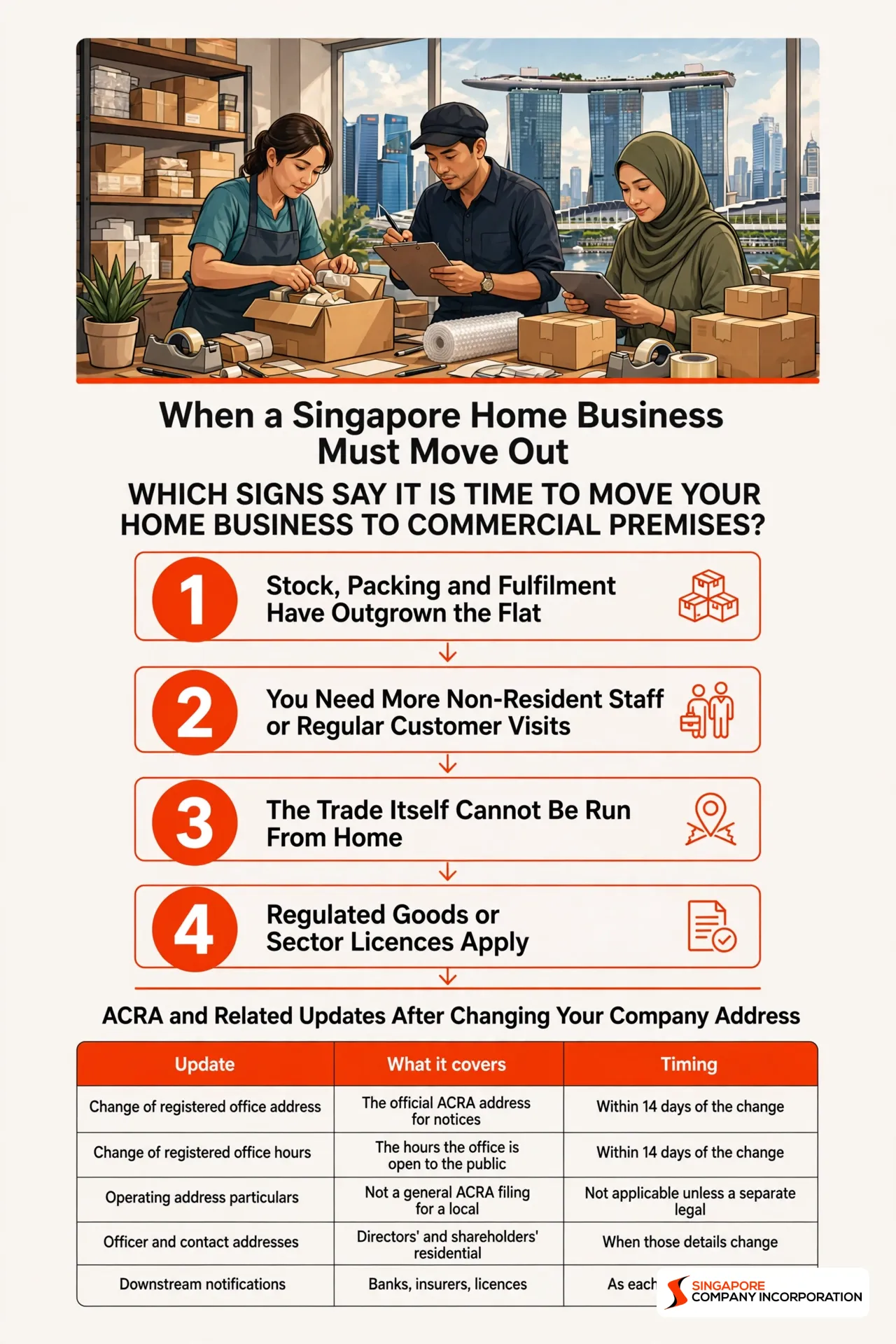
Which Signs Say It Is Time to Move Your Home Business to Commercial Premises?
There is no statutory trigger date. What tells you a home business needs commercial premises is the mismatch between what is actually happening at the flat and what the schemes permit. This is not an official priority order; it reflects the team's experience with founders, based on the boundaries URA and HDB publish.
As a broad rule, the move is overdue once the activity creating the residential-use problem cannot be brought back inside the scheme conditions.
1. Stock, Packing and Fulfilment Have Outgrown the Flat
Dense carton storage in a spare room and courier collections on most weekdays sit outside both schemes. Even when household members do the packing, the resulting traffic and nuisance can breach home-based conditions. This is usually the first activity that belongs in a proper storage or fulfilment unit.
2. You Need More Non-Resident Staff or Regular Customer Visits
The Home Office Scheme caps non-resident participants at two, and neither scheme allows material client traffic. A third non-resident worker or a steady stream of appointment-based customers means the activity has outgrown the home, whatever the paperwork says.
3. The Trade Itself Cannot Be Run From Home
Large-scale production, food processing and personal services may require commercial premises and sector approvals, but the Home-Based Business Scheme permits certain small-scale food and beauty services subject to its conditions. A home registration never replaces those requirements. If you are starting a hair salon business in Singapore, plan for licensed premises from the outset rather than a home-based workaround.
4. Regulated Goods or Sector Licences Apply
Before relocating food processing, storage or retail, check the activity-specific Singapore Food Agency (SFA) licence and whether the proposed premises are suitable. Storage of petroleum or flammable materials beyond SCDF's stipulated exemption quantities requires an SCDF licence, while hazardous substances may require separate NEA licences or permits. Do not assume every battery, cosmetic or aerosol is covered; classify the actual material first. A cooked-food venture has a different route again, and starting a hawker stall business in Singapore involves its own premises and licensing steps.
In What Order Should You Relocate the Business?
Sequence matters more than speed. We recommend premises, then operations, then paperwork. Filing an address change too early or too late is where compliance problems usually begin.
This is a decision framework, not an automatic entitlement. Before relying on any part of it, verify the property owner's consent, the tenancy terms and MCST rules. Also check the applicable HDB or URA conditions for your actual home.
A practical sequence looks like this:
- Secure premises whose approved use, lease and licences cover the activity before moving anything.
- Move the activity creating the residential-use problem first: hazardous or bulky stock, then production or packing, then non-resident staff and recurring customers.
- Test deliveries, mail and access at the new site before declaring it live.
- File the registered-office change only when the new arrangement genuinely meets ACRA's accessibility and document-receipt requirements.
- Update correspondence and customer-facing addresses once those channels actually work at the new location, with forwarding notices during the transition.
How Do You Change the Registered Office Address with ACRA?
A company must notify ACRA of a change to its registered office address within 14 days; changes to lodged office hours must also be notified within 14 days unless the office is open for at least five hours during ordinary business hours on each business day. Check the current Bizfile filing fee before lodging the change. The notification covers the official ACRA address and the hours the office is open to the public.
A directors' resolution approving the change is good governance, though ACRA's electronic filing does not normally require the resolution to be uploaded. Check your company constitution, and obtain documentary proof of the right to use the new address before you file. Proof can be a tenancy agreement, owner consent, licence or registered-address service agreement.
Timing is a compliance judgement rather than a quoted ACRA rule. The prudent point is the same. File once the new arrangement can genuinely receive statutory mail and provide the required public access. Filing before handover leaves a publicly listed address where documents go uncollected.
Changing the registered office does not silently change every other record. Position holders' residential and contact addresses are separate updates when they change; a local company does not file a general operating address with ACRA, although other entity-specific particulars may need updating.
For corporate income tax, IRAS receives registered-address changes from ACRA and refreshes its records weekly, so a separate notification is generally unnecessary. GST mailing addresses and pending tax matters are the exceptions that may still need direct attention. If you would rather not manage the filings yourself, you can contact us and we will prepare and lodge the change on your behalf.
ACRA and Related Updates After Changing Your Company Address
| Update | What it covers | Timing |
|---|---|---|
| Change of registered office address | The official ACRA address for notices and records | Within 14 days of the change |
| Change of registered office hours | The hours the office is open to the public | Within 14 days of the change, unless the office is open at least five hours during ordinary business hours on each business day |
| Operating address particulars | Not a general ACRA filing for a local company | Not applicable unless a separate legal or licensing requirement applies |
| Officer and contact addresses | Directors' and shareholders' residential or contact details | When those details change |
| Downstream notifications | Banks, insurers, licences, contracts and records | As each provider requires |
What Should You Update After Moving Out?
ACRA filings are only the statutory layer. A move also touches commercial, contractual and operational records, and the ones founders overlook are rarely the ACRA ones.
This is a practical transition checklist, not a universal statutory list. Which items apply to your company depends on your sector, contracts and providers.
The records and providers most often overlooked include:
- Banks and payment providers, which may query a mismatch between ACRA records and the operating address
- Licences and GoBusiness records tied to the old premises
- Insurers, where the policy names a registered or operating address
- Landlords, CPF and payroll providers
- Key contracts, purchase orders and invoices
- Websites and letterheads showing the home address
- Courier and returns instructions showing the home address
Conclusion
Moving your home business to commercial premises in Singapore is a sequencing exercise. Classify the activity, secure compliant premises, relocate the problem activity first, then file the ACRA update within 14 days. The registered office, operating address and correspondence address can lawfully differ. Each must meet the rules that apply to it.
If your venture is outgrowing the home-based schemes, or you need a registered-office change prepared and lodged, we can help. We help clients prepare and lodge registered-office changes once the proposed arrangement is ready to meet ACRA's requirements. SG Company Incorporation supports founders with incorporation and corporate secretarial services. It also supports registered-address arrangements and ongoing compliance management, so your filings stay on schedule while you settle into the new premises.
Planning Your Company's Move Out of the Home?
Tell us where your business is heading and we will handle the ACRA filings, registered address arrangements and compliance updates that come with the move.
Frequently Asked Questions
Yes, but only if the company remains entitled to use it, the relevant HDB or URA conditions and any tenancy or MCST restrictions are satisfied, mail and legal documents are reliably handled, and the required three-hour public access can genuinely be provided. This is a decision framework, not an automatic entitlement.
A company must notify ACRA of a change to its registered office address or office hours within 14 days, using the entity-information update process in Bizfile.
Generally no. IRAS updates corporate income tax records from ACRA information, refreshing weekly. However, GST mailing addresses and pending tax matters may need direct notification, so it is worth checking rather than assuming every IRAS record has changed.
No. The scheme permits administrative office activity only, and customers may not visit the residential premises. The small-scale home-based business scheme similarly does not allow material customer traffic.
No. The registered office must be a physical Singapore address that is open and accessible to the public for at least three hours during normal office hours on each business day, and capable of receiving official communications.

SG Company Incorporation
Author
SG Company Incorporation is a Singapore corporate services provider that helps entrepreneurs and foreign investors register a company in Singapore and keep it compliant, with support for company secretarial, nominee director and tax filing needs.