What records should an overseas parent provide when its own shareholders are companies? A foreign company incorporating a subsidiary in Singapore may need evidence for several ownership layers.
ACRA, the Accounting and Corporate Regulatory Authority, identifies every shareholder and position holder in its 2026 registration process, including corporate entities. Since 16 June 2025, new companies must also provide applicable controller and nominee information from incorporation, subject to exemptions. The company's own registers are separate from ACRA's central registers. For a parent owned by other companies, the analysis may require tracing beyond the parent.
Our team would look closely at evidence gaps: registry extracts that stop one layer short, a transfer shown on a chart but missing from the records, or a signatory whose authority has not been confirmed.
In this blog, we discuss what ACRA requires in 2026. We also cover the records a provider might ask a foreign parent to provide at each ownership layer. We outline how document mismatches can be addressed before filing. Finally, we explain who handles what between the parent and its corporate services provider.
Table of Contents
What Singapore Subsidiary Corporate Shareholder Documents Does ACRA Need?
ACRA's 2026 filing needs the subsidiary's own particulars, plus identifying details for each corporate shareholder and controller. An ownership-chain evidence pack may support a provider's due diligence; it is not a universal ACRA attachment.
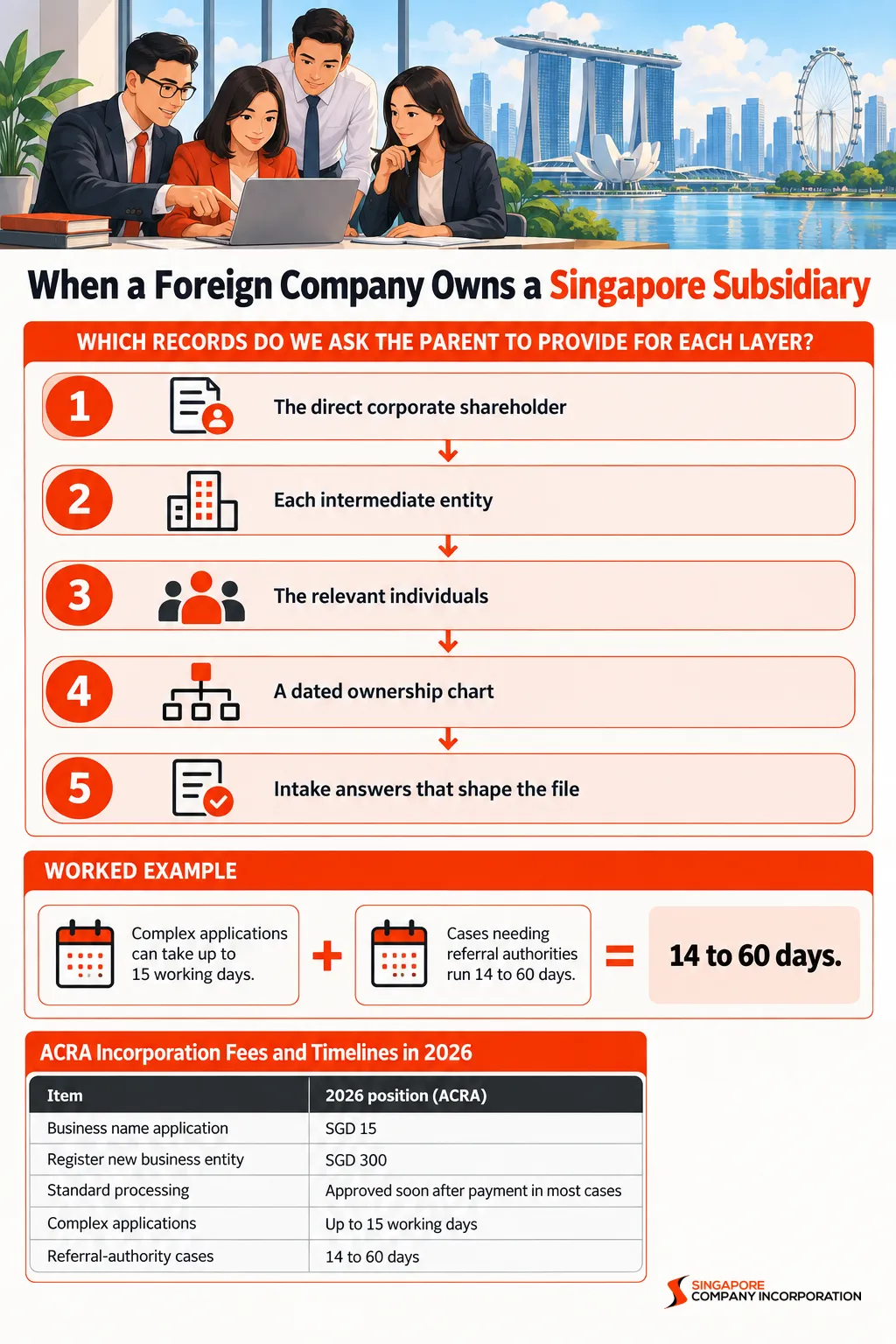
Under ACRA's Bizfile process, you reserve a name first and then register the company. The name application costs SGD 15 and registration costs SGD 300 under ACRA's 2026 fee schedule. Most registrations are approved soon after payment. Complex applications can take up to 15 working days, and cases needing referral authorities run 14 to 60 days.
The filing itself covers the approved name, financial year end, a Singapore registered office open to the public during business hours, a company constitution, officer details, and share capital and shareholder particulars. A corporate shareholder is a position holder, so ACRA needs its identifying details, not its entire overseas file.
ACRA's guide states that only limited liability partnerships (LLPs), including accounting LLPs, may be added as corporate shareholders of an exempt private company. Check the company type at the start: a subsidiary owned by a corporate parent that is not an LLP needs a different type.
A registered corporate service provider (CSP) can submit the application on your behalf. Other position holders must endorse the registration within 60 days of submission, unless a CSP or Group of Companies filed it for you. For a fuller Singapore company incorporation costs breakdown, see our first-year fee guide.
How Do You Map a Corporate Ownership Chain Above the Parent?
Start by identifying the parent's owners and tracing the relevant ownership and control links; the applicable endpoint depends on the facts and ACRA's rules. The register you keep is only as good as that trace.
Here is a purely illustrative structure for explaining the layers — not a client case. A UK trading company incorporates a wholly owned Singapore subsidiary. A Hong Kong holding company and a UK investment company own the UK parent.
Two individuals own the Hong Kong company equally, and a third individual wholly owns the UK investment company. On those assumed shareholdings, the three individuals would hold indirect economic interests in different proportions. These are assumed shareholdings for illustration, not confirmed client data, and they describe economics rather than control.
The Companies Act 1967 requires companies, unless exempt, to obtain and maintain beneficial ownership information. The chain may need to be traced above the parent to identify registrable controllers, although exceptions can apply where an intermediate controller meets ACRA’s criteria.
Our suggested analysis also examines voting rights, director-appointment rights and shareholder agreements before concluding who controls the entity. ACRA's controller tests — including significant interest or voting rights and other forms of significant control — must then be applied to the actual facts. () Simple multiplication of economic interests alone does not decide controller status.
Example Ownership Chain for a Foreign-Owned Singapore Subsidiary
| Layer | Assumed ownership | Indirect economic interest |
|---|---|---|
| Singapore subsidiary | Wholly owned by the UK parent | — |
| UK parent (direct shareholder) | 70% Hong Kong holding company, 30% UK investment company | — |
| Hong Kong holding company | Two individuals, 50% each | 35% each (assumed) |
| UK investment company | One individual, 100% | 30% (assumed) |
Which Records Do We Ask the Parent to Provide for Each Layer?
Our team's proposed approach is to gather evidence for the relevant layers. We seek existence, ownership and control records. We also seek identity evidence for individuals in scope. When choosing a corporate service provider, confirm its checklist, service scope and any alternatives. This matters for listed entities, funds, trusts or nominees.
This is our suggested pack as a corporate services provider. Registered providers have their own due-diligence and beneficial-ownership obligations. These sit apart from the new company's registers. The three exercises overlap, but they are not the same.
Our suggested approach is that higher-risk or complex structures may warrant extra corroboration. Funding information may also be needed. Confirm the provider's enhanced-review procedures. Additional documents do not make a prohibited transaction permissible.
1. The direct corporate shareholder
A proposed pack includes incorporation and name-change records. It includes a current registry extract and constitution. It includes the register of members and director details. It could also include a board resolution approving the Singapore investment and authorising a signatory.
2. Each intermediate entity
A suggested approach is to obtain equivalent existence, ownership and control records, using each jurisdiction's local document types. Insisting on British document names for a Hong Kong or European entity only creates confusion.
3. The relevant individuals
Identity documents, residential-address evidence and screening information for the individuals in scope, including the parent's authorised signatory. Evidence of that person's signing authority is part of the same step.
4. A dated ownership chart
A chart confirmed by an authorised representative and reconciled against the underlying records. The chart explains the chain; the underlying records support it. This is a proposed working method, not a confirmed description of the firm's procedure.
5. Intake answers that shape the file
The proposed intake covers several items.
- Who legally holds the Singapore shares.
- Who owns and controls each subsequent layer.
- Whether any entity is listed, a fund, a trust or a nominee.
It also covers purpose, activities, customers, funding, director-appointment rights and higher-risk indicators. The firm's questionnaire needs confirmation and is not a fixed ACRA form.
What Mismatches Should You Expect in the Ownership Records?
A recent share transfer may appear in the chart but not in the records supplied. An omitted intermediate layer may also appear. Inconsistent entity names after a change deserve attention. These are suggested checks, not a ranking of observed cases.
An old incorporation certificate is not automatically a problem. It establishes that the entity was incorporated. It does not show who owns it today. It needs supplementing with current records, not replacing.
A filed annual return may also legitimately show an earlier reporting date. Differing dates across documents are something to reconcile. They are not immediate evidence of error. Our team suggests comparing each record's effective date and purpose before drawing conclusions.
Our suggested workflow is a single discrepancy schedule. It identifies each entity and the conflicting documents. It records their effective dates and the exact evidence needed. The proposed workflow retains conflicting records rather than discarding them. If a material ownership, identity or authority conflict stays unresolved, the suggested approach is to hold acceptance or filing. Escalate before proceeding. Confirm the firm's stop-filing criteria and approval roles.
1. A transfer missing from the evidence
A provider could ask for the updated statutory ownership record and supporting transfer or allotment evidence. Confirmation from the relevant company secretary or registered agent helps where the registry is slow to update.
2. A name that differs across documents
A provider could request the official change-of-name record and retain both versions. A name change is one possible explanation for inconsistent names.
3. A layer without legal identity
The proposed approach is to obtain the entity's full legal name and registry details. It also includes ownership records to substantiate its place on the chart.
4. A registry entry that conflicts with the records
Where a filing is actually wrong, a provider could ask for correction evidence. We would not ask that a correct historical return be rewritten to match a later transaction.
Record Mismatches and the Evidence We Request
| Mismatch | What it can mean | Evidence we request |
|---|---|---|
| Transfer in the chart, not in the records | Ownership evidence is out of date | Updated statutory register plus transfer or allotment evidence |
| Entity name differs across documents | A name change has not been evidenced | Official change-of-name record |
| A layer appears without legal identity | An omitted intermediate company | Full legal identity, registry details and ownership records |
| Registry entry conflicts with the records | A filing error or a superseded filing | Correction evidence, keeping correct historical filings intact |
How Do We Treat Foreign-Language Documents?
Our team's proposed approach is to keep each source document. We obtain an English version that allows the relevant facts to be checked. The right approach depends on what the document is for. It does not depend on nationality alone.
An official bilingual registry extract that contains the necessary information is usually usable as supplied. Where a document is not in English, our suggested standard is risk-based. It is not a universal rule.
We would require a complete translation of the relevant material by an independent professional translator. This applies to a non-English ownership register. It also applies to a constitutional provision affecting control. It applies to any document on which an unresolved discrepancy turns. Under this proposed approach, the translator would be identified and their accuracy certified. An informal client summary or machine translation would not establish ownership. The firm's policy and accepted translators and certifiers need confirmation.
Documents actually submitted to ACRA must separately meet the applicable English-language and certification requirements for that filing. We would not assume a universal sworn-translation, notarisation or apostille rule for every overseas record. An apostille authenticates a public signature or seal. It does not confirm that an ownership statement is correct.
Translation Approach by Document Type
| Document situation | Practical approach |
|---|---|
| Official bilingual registry extract | Use as supplied, keeping the source on file |
| Non-English ownership register | Full professional translation with accuracy certification |
| Constitutional clause affecting control | Professional translation of the relevant provision |
| Client summary or machine translation | Not relied on to establish ownership |
Who Prepares What, and What Happens After Incorporation?
A provider could prepare and lodge the Singapore filings. The parent supplies records, approvals and authorised signatures. A parent coordinator could obtain overseas records from company secretaries, registries or agents. The provider specifies and reviews the evidence. Confirm that division of work for the engagement. Parents managing this from overseas can read how foreigners can incorporate a Singapore company remotely. Our team suggests confirming the provider's scope and filing arrangements before work begins. Contact our team to discuss your ownership chain.
1. What we handle
We handle the name application and activity and referral checks. We also handle the incorporation particulars and the constitution. We prepare the appointment, consent and subscription documents. The proposed scope also includes identifying the registrable-controller and nominee particulars to collect. We then lodge the filings once prerequisites are met. Confirm the firm's actual scope and authorised arrangements.
2. What the parent supplies
Authentic foreign records, an explanation of ownership and funding, proposed officers and controllers, and the investment approval with authorised signatures. A resolution template helps, but the parent must approve it under its own governing law and constitution.
3. Singapore requirements at and after incorporation
At incorporation, the company needs a director who meets Singapore's applicable residency and eligibility rules. It also needs a Singapore registered office. It must appoint a secretary within six months. A sole director cannot also be the secretary. Initial registers and filings may form part of an agreed service scope. A nominee director remains a director with statutory duties. Applicable nominee and nominator information must be provided.
4. What incorporation does not do
It does not by itself open a bank account, secure immigration permission or authorise a regulated activity. ACRA's post-registration guidance is clear that additional licences or permits may be needed before operations begin. That depends on the activity and its regulator. Non-compliance with registered-office hours can also attract a fine of up to SGD 5,000.
ACRA Incorporation Fees and Timelines in 2026
| Item | 2026 position (ACRA) |
|---|---|
| Business name application | SGD 15 |
| Register new business entity | SGD 300 |
| Standard processing | Approved soon after payment in most cases |
| Complex applications | Up to 15 working days |
| Referral-authority cases | 14 to 60 days |
| Non-filing position-holder endorsements | Within 60 days of submission |
Conclusion
When a foreign parent registers a Singapore subsidiary, two files matter: ACRA's and your provider's. ACRA's 2026 filing needs the subsidiary's particulars, the corporate shareholder's identifying details and the applicable controller and nominee information. Our team suggests mapping the chain layer by layer and reconciling each link against supporting records.
An unevidenced transfer, an unnamed layer or a name change may need clarification before filing. The proposed evidence pack goes beyond the minimum form fields; translations, signatory authority and control rights should also be considered. Confirm the firm's checklist and service scope for your engagement.
SG Company Incorporation supports local entrepreneurs and foreign owners with company incorporation, corporate secretarial services, nominee director arrangements where appropriate, and ongoing tax and compliance management. Talk to us at our Goldhill Plaza office about your ownership chain before you file.
Map Your Ownership Chain Before You File
Share your parent company's structure with us to discuss the evidence that may be needed at each layer.
Frequently Asked Questions
Yes, subject to the company type: an exempt private company has restrictions on corporate shareholders. ACRA needs the shareholder's identifying details. Other position holders must endorse within 60 days unless a corporate service provider or Group of Companies filed the application.
The incorporation filing needs the corporate shareholder's particulars and applicable controller and nominee information. A full ownership-chain evidence pack may support the provider's due diligence; it is not a universal ACRA attachment to every application.
Not automatically. ACRA's controller tests include significant interest or voting rights and other forms of significant control, applied to the actual facts. An economic interest alone does not decide controller status.
No. It proves the entity was incorporated, not who owns it now. Our team suggests supplementing it with current registry and ownership records rather than treating the certificate itself as stale.
Not universally. Our proposed approach is to keep source documents and consider official bilingual extracts where they contain the necessary facts. Documents actually submitted to ACRA must meet the applicable English-language and certification requirements for that filing.

SG Company Incorporation
Author
SG Company Incorporation is a Singapore corporate services provider that helps entrepreneurs and foreign investors register a company in Singapore and keep it compliant, with support for company secretarial, nominee director and tax filing needs.